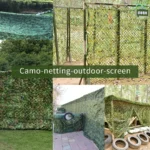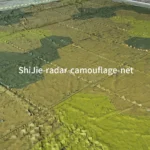
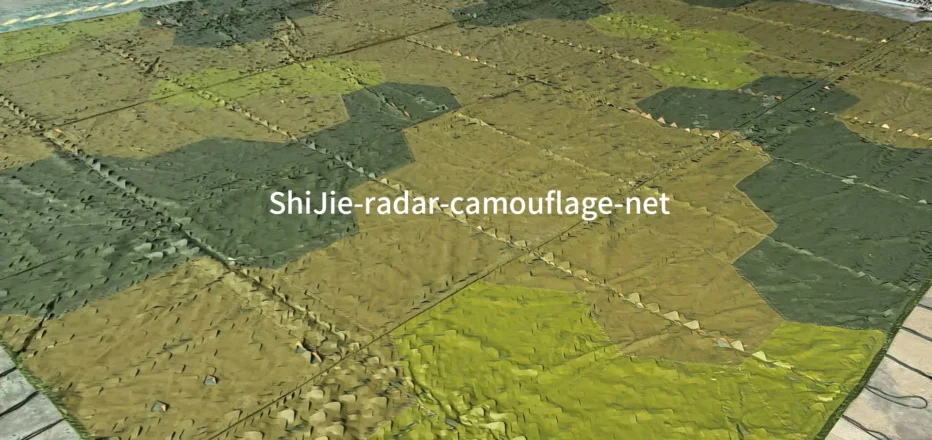
A radar camouflage net is a specialised covering designed to modify the radar signature of the object beneath it. It uses engineered materials and construction to influence how radio waves interact with the covered object, helping reduce its radar contrast or make its signature less recognisable under specified conditions.
Its function extends beyond the visible appearance of a conventional camouflage net. Green, brown, or desert-coloured fabric can help an object blend into its surroundings, but the printed pattern alone does not establish radar performance.
SHIJIE produces radar camouflage nets as part of its specialised camouflage material range. These products combine camouflage structures with radar-related functional materials, with the final configuration selected according to project requirements.
Understanding the difference between visual camouflage and radar signature management helps buyers specify the right product and request meaningful performance documentation.
Why Radar Camouflage Requires Specialised Materials
Radar systems transmit radio waves and analyse the returned signals. An object’s shape, dimensions, materials, and orientation affect that return.
A net that conceals an object from a camera may still allow radio waves to interact with the object underneath. Visual colour matching therefore answers a different question from radar performance.
Specialised camouflage systems address these different sensor responses separately. Saab’s public explanation of signature management, for example, describes distinct technologies for visible, infrared, thermal, and radar functions, with radar-related materials positioned within the layered construction of its systems.
For buyers, the practical implication is straightforward: radar camouflage must be specified and evaluated as an electromagnetic function, rather than inferred from a military-looking pattern.
How Does a Radar Camouflage Net Work?
Radar camouflage changes the interaction between incoming radio waves, the net, and the covered object.
Depending on the design, its materials may alter scattering, attenuate transmission, or absorb part of the incident energy. The net and the object together form a system, so the resulting radar response cannot be determined from the net’s appearance alone.
The purpose is signature management. It does not mean that the object becomes invisible to every radar.
Performance depends on factors such as:
- Frequency range
- Signal polarization
- Observation angle
- Net construction
- Covered object
- Environmental conditions
- Test configuration
A product may perform differently across these conditions. This is why a general claim such as “anti-radar” needs a defined specification and supporting measurements.

Radar Camouflage, Visual Camouflage, and Infrared Camouflage
These terms describe different performance requirements.
| Camouflage function | What it addresses | What buyers should verify |
|---|---|---|
| Visual camouflage | Colour, texture, outline, and visible contrast | Approved pattern, surface finish, and appearance |
| Near-infrared camouflage | Reflected near-infrared radiation | Spectral reflectance under a specified test |
| Thermal camouflage | Thermal radiation and contrast | Performance in the required infrared bands and conditions |
| Radar camouflage | Interaction with radio-frequency signals | Defined radar-related measurements across the required frequencies |
| Multispectral camouflage | Several sensor bands within one system | Separate evidence for each claimed function |
A radar camouflage net may also provide visual or infrared functions, but each capability needs its own evidence.
Official U.S. Army product information describes ULCANS as a multispectral system addressing visual, near-infrared, short-wave infrared, thermal, and radar signatures. This illustrates the breadth of a specialised system; it does not establish equivalent performance for another manufacturer’s product.
Radar-Scattering and Radar-Transparent Nets
Buyers may encounter two terms that sound similar but describe different purposes.
Radar-scattering nets deliberately modify the interaction with radar signals as part of a concealment system.
Radar-transparent nets are designed to allow signals to pass through within specified requirements. They may provide other camouflage functions while limiting interference with equipment that needs radio-frequency transmission or reception.
The U.S. defence specification for ULCANS Increment I explicitly distinguishes radar-scattering and radar-transparent variants. They should therefore be treated as separate configurations when writing a purchase specification.
Compatibility with radar or communications equipment should be confirmed for the complete system. A product described simply as “radar camouflage netting” does not provide enough information to make that decision.
What Is a Radar Camouflage Net Made Of?
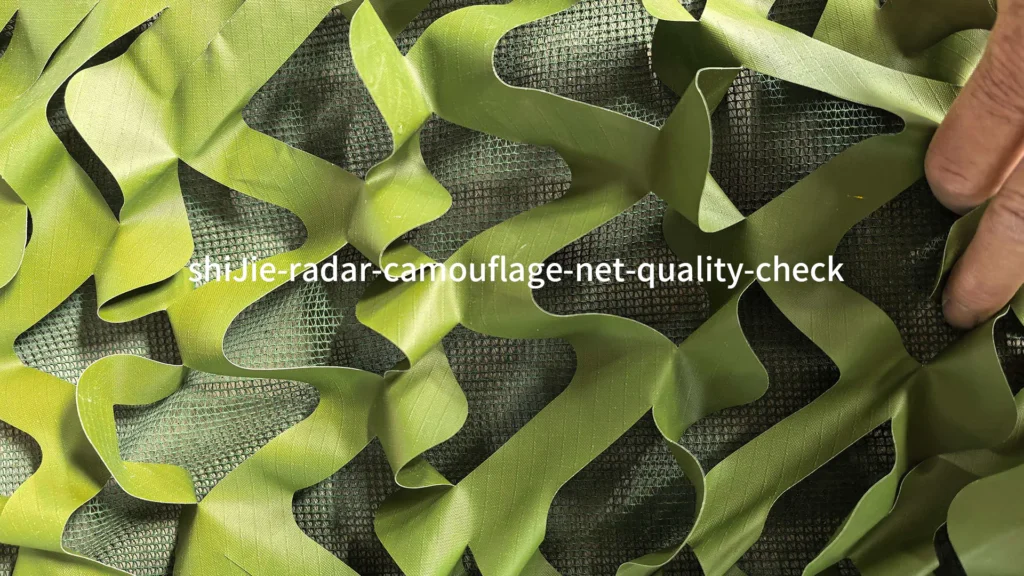
The construction varies by manufacturer and product. It can include a supporting mesh, decorative elements, engineered functional materials, reinforced edges, and connecting components.
Supporting Mesh
The mesh carries the decorative and functional components and provides structure during handling. Its material, connections, and reinforcement affect the assembled net’s physical condition.
Decorative Surface
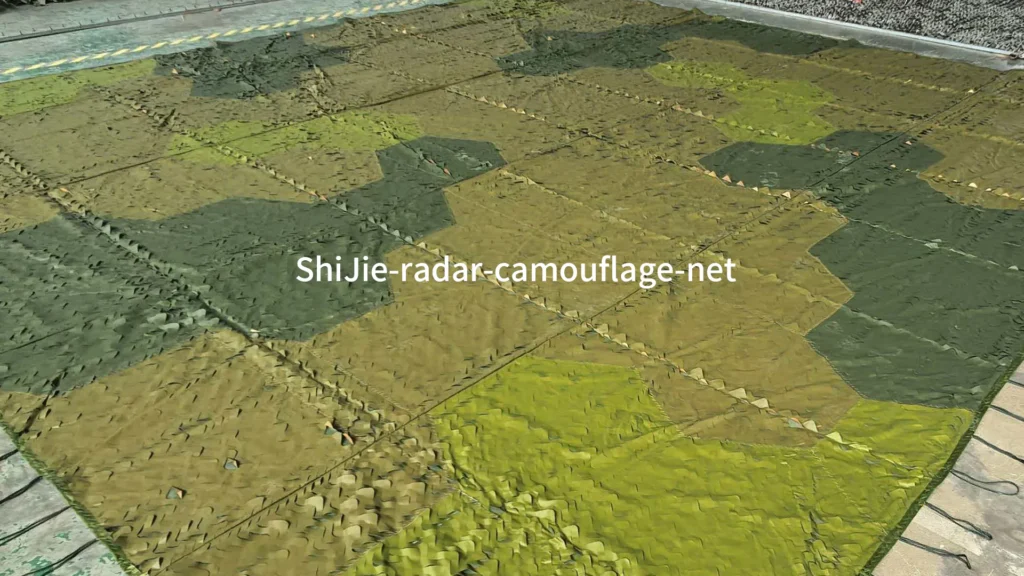
Printed fabric or three-dimensional elements provide visible colour and texture. This surface helps the product resemble a selected background while changing its manufactured appearance.
Functional Materials
Radar-related performance comes from the electromagnetic properties of the materials and their arrangement. Buyers should confirm which component provides the specified function and which measurements support it.
Edges and Connections
Binding, connecting ropes, and attachment points form part of the finished product. Their strength and condition matter because damage can change the net’s construction and continuity.
SHIJIE Radar Camouflage Net Production
Shandong Shijie New Materials Technology Co., Ltd. manufactures radar camouflage nets and related multispectral camouflage products.
The supplied product handbook describes a specialised system combining a supporting mesh, three-dimensional decorative elements, and a separate functional attenuation layer. It also presents radar-related specifications for this product family.
This construction is distinct from ordinary printed netting. The decorative surface contributes to visible camouflage, while the functional components address additional requirements.
For a SHIJIE order, the technical discussion should establish:
- Required radar-related function
- Relevant frequency range
- Test method and acceptance criteria
- Finished panel dimensions
- Layer arrangement
- Pattern and colour
- Mesh and edge construction
- Environmental requirements
- Packaging and identification
Handbook values should be confirmed against the current product specification and applicable test documentation before being incorporated into a purchase contract.
More company information is available through the SHIJIE manufacturing capabilities page.
How Should Radar Camouflage Performance Be Verified?
A test report needs to explain what was measured.
Transmission attenuation, reflection behaviour, and radar cross-section are different quantities. A value stated in decibels is meaningful only when its measurement method, reference, and conditions are clear.
For example, a transmission measurement on a material sample does not automatically establish the radar-signature reduction of a complete covered object.
Ask the manufacturer to identify:
| Test detail | Why it matters |
|---|---|
| Measured quantity | Establishes what the result actually represents |
| Frequency range | Defines where the reported performance applies |
| Polarization and geometry | Identifies the measurement conditions |
| Sample construction | Connects the report to the supplied product |
| Reference or baseline | Explains what the result is compared with |
| Environmental conditioning | Shows whether the sample was new, aged, wet, or otherwise conditioned |
| Acceptance criteria | Provides a clear pass or fail requirement |
A sample can demonstrate colour, mesh, edge finishing, and handling. Instrumental measurements are needed to establish radar-related performance.
Buyers can also review the SHIJIE quality control page when discussing inspection and documentation requirements.
Frequently Asked Questions
Can ordinary camouflage netting reduce radar detection?
Ordinary printed netting should not be assumed to provide radar camouflage. Its colour and pattern do not establish electromagnetic performance.
Is radar camouflage the same as thermal camouflage?
No. Radar and thermal sensors operate through different mechanisms and wavelength ranges. A product intended to address both needs separate performance evidence.
Does SHIJIE manufacture radar camouflage nets?
Yes. SHIJIE produces radar camouflage nets within its specialised camouflage range. Buyers should confirm the construction, required bands, and supporting documentation for the selected configuration.
Can one radar camouflage net work equally well at every frequency?
Performance varies with frequency and other conditions. The specification should identify the required range rather than rely on an unrestricted “all-band” claim.
Choosing a Radar Camouflage Net
A radar camouflage net is an engineered signature-management product whose performance depends on its materials, construction, and specified conditions.
For buyers sourcing from SHIJIE, the starting point is a clear technical requirement supported by an approved product configuration and relevant measurements.
To discuss production or customization, contact SHIJIE with your dimensions, pattern requirements, intended application, quantity, and radar-related acceptance criteria. This gives the factory a concrete basis for proposing a product and preparing a quotation.