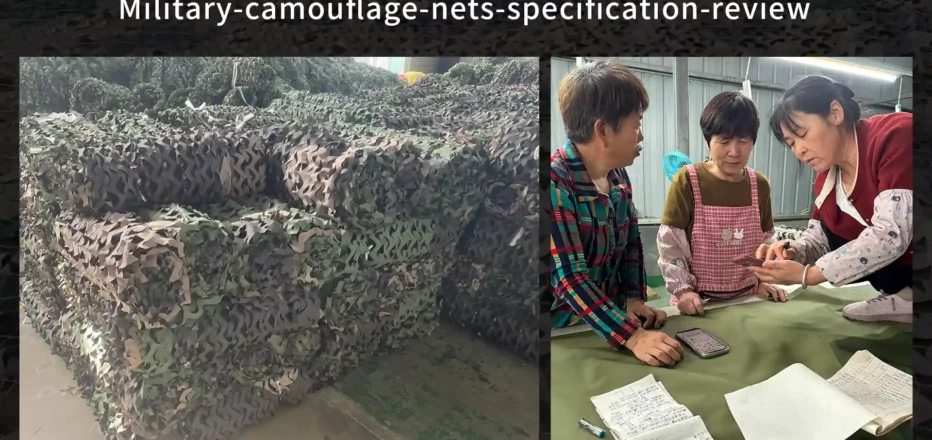
The key standards for Military Camouflage Nets cover the applicable product specification, visual appearance, spectral performance where required, flame behaviour, mechanical strength, environmental durability, and inspection records. A military-style pattern alone does not establish compliance.
The first buying decision is which requirements govern the order. Different programmes can specify different backgrounds, radar behaviour, environmental conditions, and acceptance tests. There is no single worldwide “military grade” label that replaces those details.
This guide explains what buyers should check, how test methods differ from pass limits, and how to prepare a clear enquiry for SHIJIE.
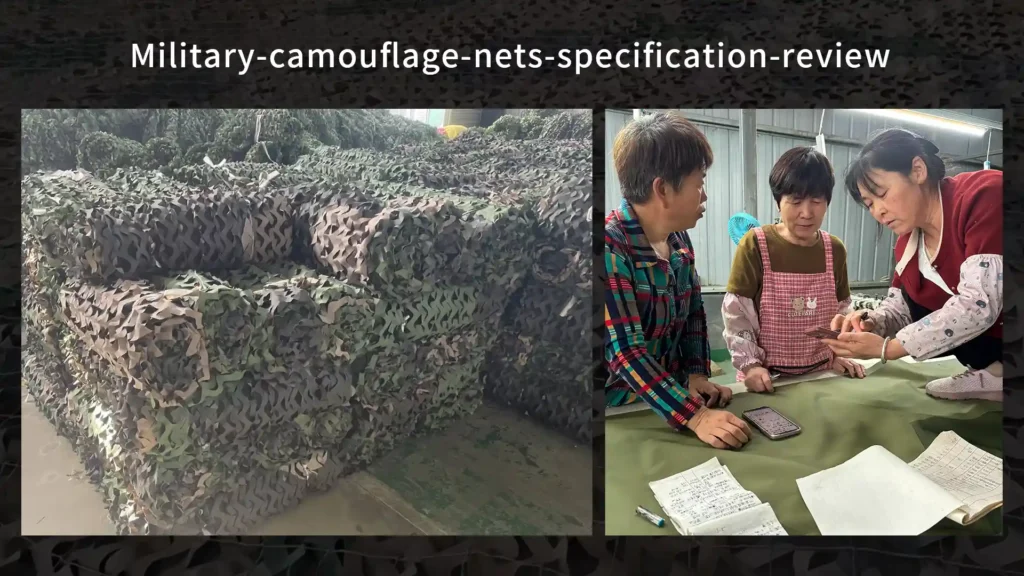
1. Confirm The Governing Specification And Edition
A standards review starts with the complete document reference: designation, title, revision, amendments, and applicable product type. Also confirm the contract’s rules for resolving differences between documents.
Public catalogues can contain older references. As checked on October 29, 2026, the US Defense Logistics Agency’s official records show the following:
| Reference | Official Public Record | What Buyers Should Confirm |
|---|---|---|
| MIL-PRF-53134 | ULCANS performance specification; listed as Inactive, with an inactivation notice dated May 15, 2025 | Whether an existing contract explicitly invokes it |
| MIL-PRF-32575 | ULCANS Increment I; listed as Active, Revision D dated October 17, 2024 | Applicable configuration and authorised access to the required document |
| Contract-specific requirements | Requirements selected for the actual procurement | Product type, methods, limits, conditioning, and required evidence |
The official records distinguish the inactive MIL-PRF-53134 from the active MIL-PRF-32575 specification.
The MIL-PRF-32575 catalogue record identifies both radar-scattering and radar-transparent variants. It also marks the document as controlled distribution. The public record establishes its title, status, and general scope; it does not provide a basis for inventing detailed acceptance limits.
The MIL-PRF-53134 record should likewise be read with its status notice. Do not present it as a universally current requirement for new orders.
For a Chinese GJB-based enquiry, obtain the full referenced documents and confirm their editions and applicability. A standard number copied into a commercial summary is not enough to establish the governing requirements.
2. Define Visual Colour And Pattern Requirements
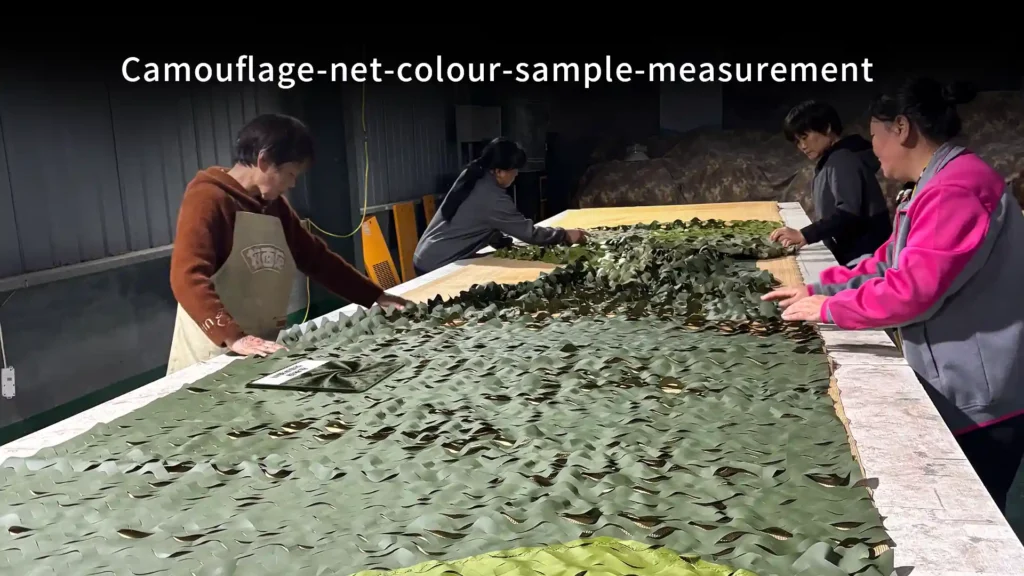
Visual requirements commonly concern the approved colours, their distribution, pattern layout, and surface appearance. The background and intended configuration must be clear before colour can be accepted.
Use a physical reference sample where possible. Product photographs and screen images can assist discussion, but they should not be the only production colour standard.
Specify The Colour-Difference Method
A requirement such as “colour difference no greater than 3” is incomplete without its measurement conditions. Confirm the colour-difference formula, reference sample, instrument geometry, illuminant, observer, and sample preparation.
For example, ΔE*ab ≤3 can be a selected purchasing requirement. It is not a universal limit for every camouflage colour, material, or military programme. Do not treat different colour-difference formulas as interchangeable.
Check Pattern And Surface Separately
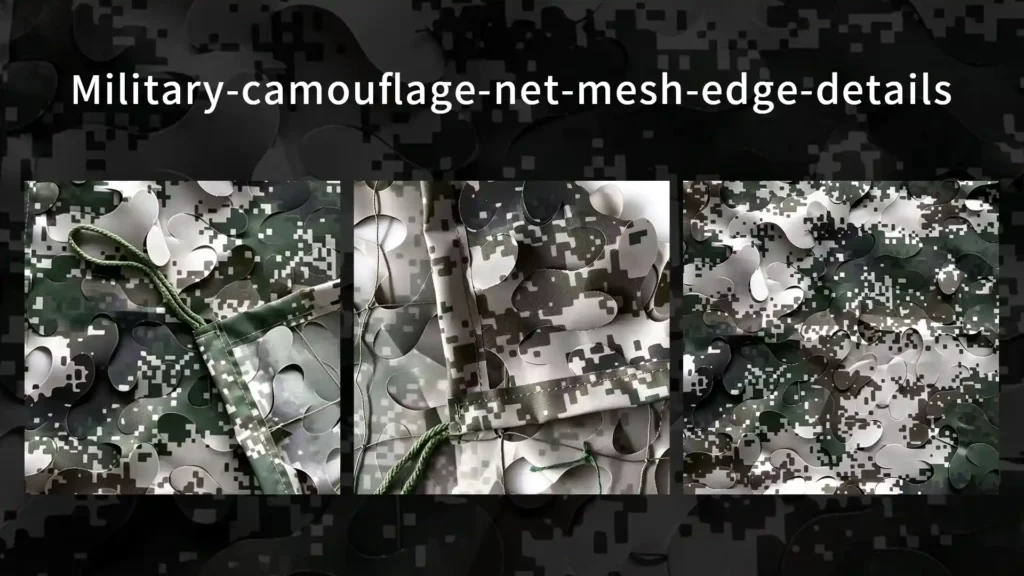
Colour agreement does not establish correct pattern placement or low gloss. Inspect the print layout, reverse face, edges, and visible accessories as relevant to the order.
For basic construction terminology, our explanation of camouflage net structure and uses helps distinguish the surface fabric, supporting mesh, and finishing details.
3. Treat Near-Infrared Performance As A Separate Requirement
Near-infrared, or NIR, performance cannot be confirmed by looking at a green fabric in daylight. Visual appearance and spectral reflectance are different measurements.
For Military Camouflage Nets with NIR requirements, request the specified reflectance limits across the relevant wavelength range. The report should identify the colour areas tested, measurement method, sample condition, and applicable acceptance criteria.
A single reflectance percentage is not a complete spectral specification. “Higher than 50%” does not establish suitability for every background or wavelength. A measured curve must be compared with the required limits, which may differ between colours.
Also distinguish reflectance from emissivity. Reflectance concerns incident radiation reflected by a surface. Emissivity concerns thermal emission relative to a reference. The terms should not be substituted in a requirement or test report.
If a wavelength interval spans visible light and NIR, identify that correctly. Avoid calling the entire interval exclusively near-infrared.
4. Define Thermal-Infrared Test Conditions
Thermal-infrared performance is another separate question. An NIR result does not demonstrate a thermal-camera result.
A procurement may define a thermal-imaging band and a permitted apparent temperature difference from a reference background. Those values only become meaningful with a complete test procedure.
For example, a requirement expressed as “within ±4°C” needs a defined comparison. Buyers should confirm the tested assembly, background, environmental conditions, instrument settings, measurement interval, and evaluation method.
Distinguish apparent radiometric temperature from directly measured physical temperature. A thermal image is not automatically a measurement of the surface’s true contact temperature.
Request reports for the supplied configuration. Results from one fabric layer, a different support arrangement, or another product should not automatically be applied to the complete net being purchased.
5. State The Required Radar Behaviour Precisely
“Radar camouflage” is too broad to define an order. The official ULCANS Increment I scope includes radar-scattering and radar-transparent variants, so buyers must identify which behaviour the application requires.
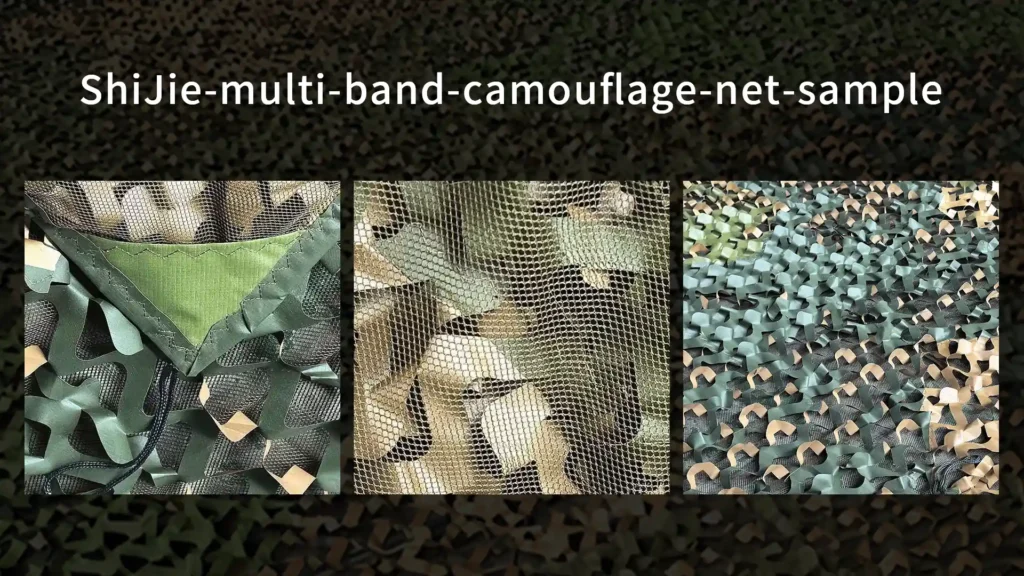
Reports should state the applicable frequency range, measured quantity, sample configuration, and test conditions. A marketing label such as “multi-band” does not replace those details.
Be careful when comparing percentages and decibels. A transmission percentage and an attenuation figure cannot be compared reliably unless the measurement definitions and calculation convention are known.
Transmission through a material is also a different quantity from a complete object’s radar response. A material result should not be presented as an identical reduction for every covered object.
SHIJIE lists the CamoNet Multi-Band Y / W / G for project-specific multispectral enquiries. Its product information states that radar attenuation values must be confirmed according to the selected model, specification, and test report.
6. Separate Flame Test Methods From Pass Limits
Flame behaviour should be defined by a test method and acceptance criteria, not simply the words “fire-resistant.”
ASTM D6413/D6413M, for example, is a vertical textile flame test that measures afterflame time, afterglow time, and char length. Naming this method does not itself establish a particular military pass limit.
If an order requires afterflame time of no more than five seconds, write that limit into the specification together with the agreed procedure and other required results. A report showing a different limit does not prove the stricter requirement has been met.
Confirm whether results apply to the finished coating and construction. Include any required conditioning, cleaning, or ageing before testing. A treatment description alone is not equivalent to a report for the supplied material.
7. Specify Colourfastness And Environmental Durability
Matching an approved colour when new is different from retaining it after exposure. Both can matter, and they need separate checks.
Two examples of relevant textile methods are:
- ISO 105-B02:2014: Colourfastness to artificial light using a xenon arc source.
- ISO 105-X12:2016: Colourfastness to rubbing, with dry and wet tests available.
The official ISO light-fastness description and rubbing-fastness description explain their respective scopes. Neither method is a complete military-net qualification by itself.
When a supplier states “Grade 4,” ask which test and rating system produced that result. A light-fastness grade and a rubbing-fastness grade describe different evaluations.
For environmental durability, define the exposures relevant to the project. These may include temperature, humidity, sunlight, rain, fungal growth, salt exposure, or fluid contact. Also define what must remain acceptable after exposure.
A fungus-resistance result is not proof of corrosion resistance. Colour retention is not proof of retained strength. An accelerated exposure duration is not automatically equivalent to a stated number of outdoor service years.
8. Check Mechanical Strength And Finished Construction
Military Camouflage Nets must be assessed as assemblies, not only as fabric swatches. The relevant mechanical checks may cover surface material, supporting mesh, seams, decorative attachments, edge ropes, and connectors.
Each result should identify the component, method, units, test direction, and sample condition. Do not compare fabric tear strength directly with rope breaking force or mesh bursting strength.
Denier describes yarn linear density. It is useful material information, but it does not establish the strength or qualification of the complete system.
For example, a reinforced outdoor product such as SHIJIE CamoNet Pro 420D has its own defined construction. Its fabric grade should not be used as evidence that it meets an unrelated military specification.
Finished inspection should also cover dimensions, edge work, attachment locations, appearance, and packing. Where reuse or repairability is required, define the evaluation and allowable condition after the prescribed use cycles.
What Documents Should A Buyer Request?
Create a compliance matrix before comparing quotations. It connects each requirement to its evidence and makes gaps easier to identify.
| Requirement Area | Information To Agree | Evidence To Review |
|---|---|---|
| Governing specification | Designation, edition, amendments, and product type | Controlled requirements list |
| Visual appearance | Colour reference, pattern, gloss, and tolerances | Approved sample and applicable measurements |
| Spectral functions | Required bands, measured quantities, and limits | Reports for the specified configuration |
| Flame behaviour | Method, conditioning, and acceptance limits | Results for all required flame-test measures |
| Durability | Exposure conditions and retained properties | Environmental and colourfastness reports |
| Mechanical performance | Component, method, direction, and limit | Traceable strength-test results |
| Finished delivery | Dimensions, accessories, identification, and packing | Final inspection and release records |
Check the sample identity, report date, laboratory, methods, and result pages. Confirm that the tested material and finish match the quotation. Where accredited testing is required, check that the laboratory’s relevant scope covers the requested activity.
Testing, certification, and production inspection are different forms of evidence. Ask what an offered certificate actually covers rather than accepting the word “certified” on its own.
How SHIJIE Supports A Specification-Based Enquiry
At SHIJIE, we start with the buyer’s application and documented requirements. Shandong Shijie New Materials Technology Co., Ltd. supplies camouflage textiles with different materials, structures, colours, dimensions, and specified finishing options.
Our camouflage net range includes visual-screening products and specialised multi-band configurations. Selection begins by identifying which functions the project requires and which configuration will be evaluated.
Send the governing specification, required tests, panel dimensions, quantity, background, exposure conditions, and delivery destination. We can review the proposed construction and discuss the sample and evidence needed before production approval.
No general catalogue description should be read as blanket certification to every military standard. Compliance must be assessed against the actual order, product configuration, and supporting records.
For broader purchasing preparation, see our guide to choosing and using camouflage netting. A clear enquiry gives both buyer and manufacturer a practical basis for identifying suitable options.
Frequently Asked Questions
Is There One International Standard For Military Camouflage Nets?
No single standard governs every military programme. The applicable requirements depend on the buyer, product type, intended function, and contract. Confirm the exact documents and editions before evaluating compliance.
Does NIR Performance Prove Thermal Camouflage?
No. They concern different spectral regions and measurements. Specify and verify each required function separately.
Does A Five-Second Afterflame Result Prove Full Compliance?
No. It establishes one result under the stated test conditions. Full acceptance may require other flame measures, spectral tests, strength checks, durability tests, and documentation.
Is MIL-PRF-53134 Currently Active?
The official DLA record lists it as Inactive, with a notice dated May 15, 2025. Confirm whether a particular contract invokes that document rather than assuming it is the current default.
Can SHIJIE Review A Buyer-Supplied Military Specification?
Yes. Send the applicable requirements and intended product configuration for review. Available production options and the required test evidence should be confirmed for that specific enquiry.
Define The Requirement Before Comparing The Net
The key to purchasing Military Camouflage Nets is a traceable specification. Confirm the governing documents, identify the required functions, and connect every acceptance limit with a suitable method and report.
Then evaluate the finished product and production records against that specification. Learn more about SHIJIE and send your project requirements to begin a focused technical discussion.