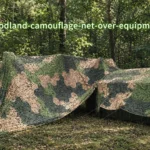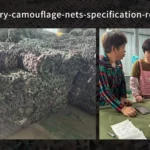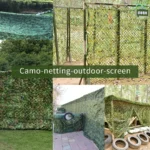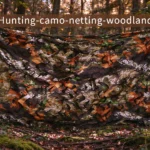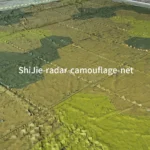

A camouflage net is a flexible covering designed to make an object less conspicuous against its surroundings. It can cover equipment, vehicles, temporary structures or open areas, changing their visible colour, texture and outline.
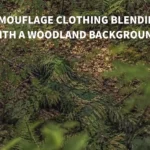
A net does not make the object underneath disappear. Its effect depends on the background, viewing angle, lighting and the way it is installed. A woodland pattern may blend into vegetation but stand out against pale sand. Even a well-chosen pattern can leave an obvious shape if the net is pulled into a flat rectangle.
Camouflage nets are also used outside defence projects. They can create visual screening, partial shade or a textured backdrop for outdoor spaces, training areas and film sets. The right construction depends on the job: a decorative covering and a reusable equipment screen need different specifications.

How Does a Camouflage Net Work?
A camouflage net reduces the visual clues that make an object easy to notice or recognise.
Colour and pattern help the covering relate to the surrounding vegetation, soil, rock or snow. Irregular shapes interrupt straight edges and familiar silhouettes. Surface texture adds depth and broken shadows that a smooth sheet cannot create.
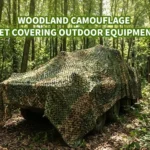
Installation matters as much as the printed pattern. A net suspended above an object can create a different outer profile from one draped tightly over it. The edges should also blend with the site: a neat square of camouflage material can still be easy to spot from above.
These principles have limits. A visual camouflage net should not be assumed to reduce detection by infrared sensors or radar. The U.S. Army describes specialised net systems that address visible and other sensor bands, which illustrates why those capabilities require a defined product and testing.
What Is a Camouflage Net Made Of?
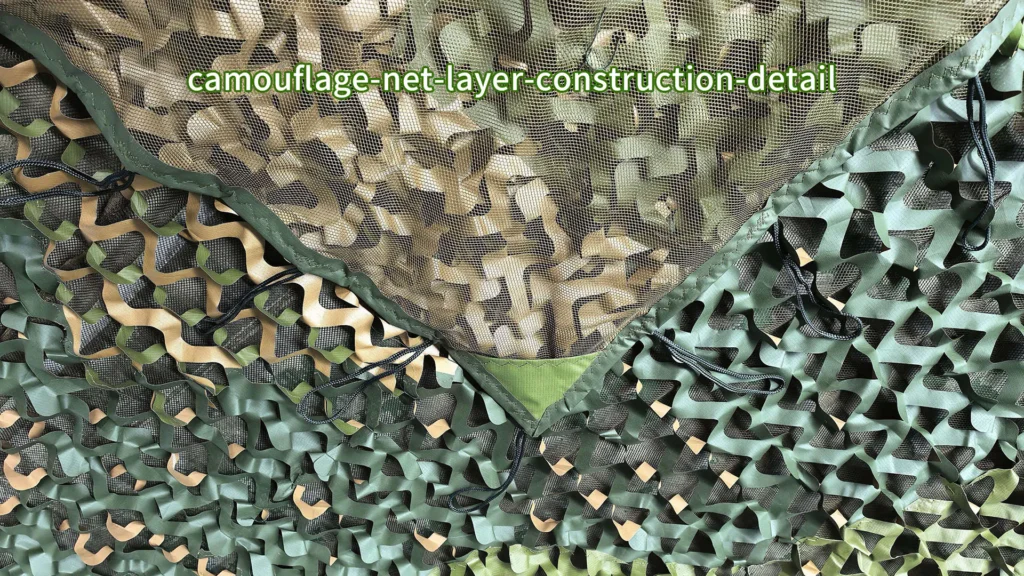
There is no single construction used for every camouflage net. A product may include several layers and components:
| Component | What it does |
|---|---|
| Camouflage fabric | Provides the printed colour and visible pattern; it may be cut or shaped to create an irregular surface. |
| Supporting mesh | Carries the fabric and provides a framework for handling and installation. |
| Edge binding | Reinforces the perimeter, where handling and fixing can concentrate stress. |
| Tie ropes or attachment points | Connect the panel to anchors, supports or another panel. |
| Optional additional layer | Adds a specified function or changes how the net behaves in use. |
In SHIJIE’s supplied product information, common fabric options are described as 150D, 210D and 420D, with single and double-layer arrangements and different supporting meshes. “D” means denier, a measure of yarn linear density. A higher denier identifies a heavier yarn at the same length; it does not, by itself, establish the finished net’s thickness, strength or service life.
The supplied range also describes single-sided printing, selected double-sided constructions, straight edge binding and a curved “W” edge. These are configuration choices. Buyers should confirm the construction of the particular item being quoted rather than assume that every colour is available in every fabric and layer combination.
Common Types of Camouflage Net
Visual camouflage nets
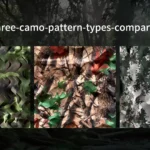
These products use colour, pattern and physical texture to reduce visible contrast. Patterns may be designed for woodland, grassland, desert, snow or another specified background. Some are reversible, allowing a different appearance on each side.
A “military-style” print describes appearance. It does not establish compliance with a military specification.
Shade and screening nets
A camouflage-pattern net may be selected for partial shade, privacy or decoration. Suitable applications include campsites, outdoor activity areas, gardens and temporary displays. The amount of shade depends on the material, coverage and openings; it should be measured or specified if it is a purchasing requirement.
Specialised signature-management nets
Some engineered systems are designed to reduce signatures in bands beyond visible light, such as near-infrared, thermal infrared or radar. These functions vary by product and must be checked separately. For example, a current U.S. defence specification distinguishes radar-scattering and radar-transparent variants, so “radar camouflage” alone is not a precise specification.
If a project needs one of these capabilities, ask for the relevant frequency or wavelength range, test method, acceptance criteria and report for the exact product configuration.
Where Are Camouflage Nets Used?
Camouflage netting can be configured for equipment covers, temporary field structures, training sites, hunting or wildlife observation where permitted, photography sets, outdoor recreation and visual screening.
The application changes the buying priorities. A film backdrop may be chosen mainly for appearance and ease of installation. A net deployed repeatedly outdoors may need stronger edges, reliable attachment points and a practical repair method. A technical procurement may require physical and spectral test results.

How Do You Choose the Right Camouflage Net?
Start with what the net must cover and where it will be used. Then give the supplier enough information to specify a complete product:
- Background and season: Share site photographs and identify the main colours and textures.
- Object and coverage: Provide length, width and height, allowing for side coverage, overlap and fixing points.
- Installation: State whether the net will be draped, wrapped or suspended, and whether it will be installed repeatedly.
- Construction: Confirm the fabric, supporting mesh, layer arrangement, edge finish and attachment points.
- Operating conditions: Describe expected sun, rain, wind, abrasion and storage conditions.
- Required performance: Identify any shade, flame, weathering or spectral requirement and the evidence needed to verify it.
The supplied product notes describe a 6.8 m × 6.8 m standard panel alongside custom dimensions. They also give example weights for particular fabric and mesh combinations. Treat these as configuration examples: the finished size, mass and tolerances should appear on the quotation or approved sample for the product you order.
For installation, keep the covering clear of hot exhausts, moving parts, ventilation openings and electrical lines. Secure it for the site’s expected conditions, and inspect its mesh, edges and anchors after use or severe weather. Official U.S. equipment guidance likewise calls for a clear setup area and warns against contact between support poles and overhead power lines.
What Can SHIJIE Supply?
Shandong Shijie New Materials Technology Co., Ltd. describes a range of camouflage net fabrics, patterns, mesh structures, edge treatments and custom sizes in its supplied materials. Buyers can discuss single or double-sided designs and provide a reference pattern or technical specification for a customised project.
The most useful first inquiry includes the intended use, background, dimensions, preferred construction, order quantity and any test requirements. This lets the supplier quote a defined configuration and provide a sample for review.
Conclusion
A camouflage net is a covering that changes how an object looks against its background. Its performance comes from the combination of pattern, fabric, supporting mesh, shape and installation.
Choose it by application and complete construction, not by a pattern photograph alone. When infrared, thermal, radar, flame or weathering performance is essential, specify the required test and confirm the results for the product being purchased.